Pine Script Strategy · Starter Plan
MES Pine Script Strategy for Prop Firm Evaluations
MES is the S&P 500 micro contract — the most forgiving instrument for a first prop firm eval. At $1.25/tick, you have room to use meaningful stops without eating your daily loss budget in two trades. The strategy we actually run: ATR 10 Trail on the 15-minute RTH chart. 46.01% win rate across 276 trades, +$15,420 net, $8,829 max drawdown.
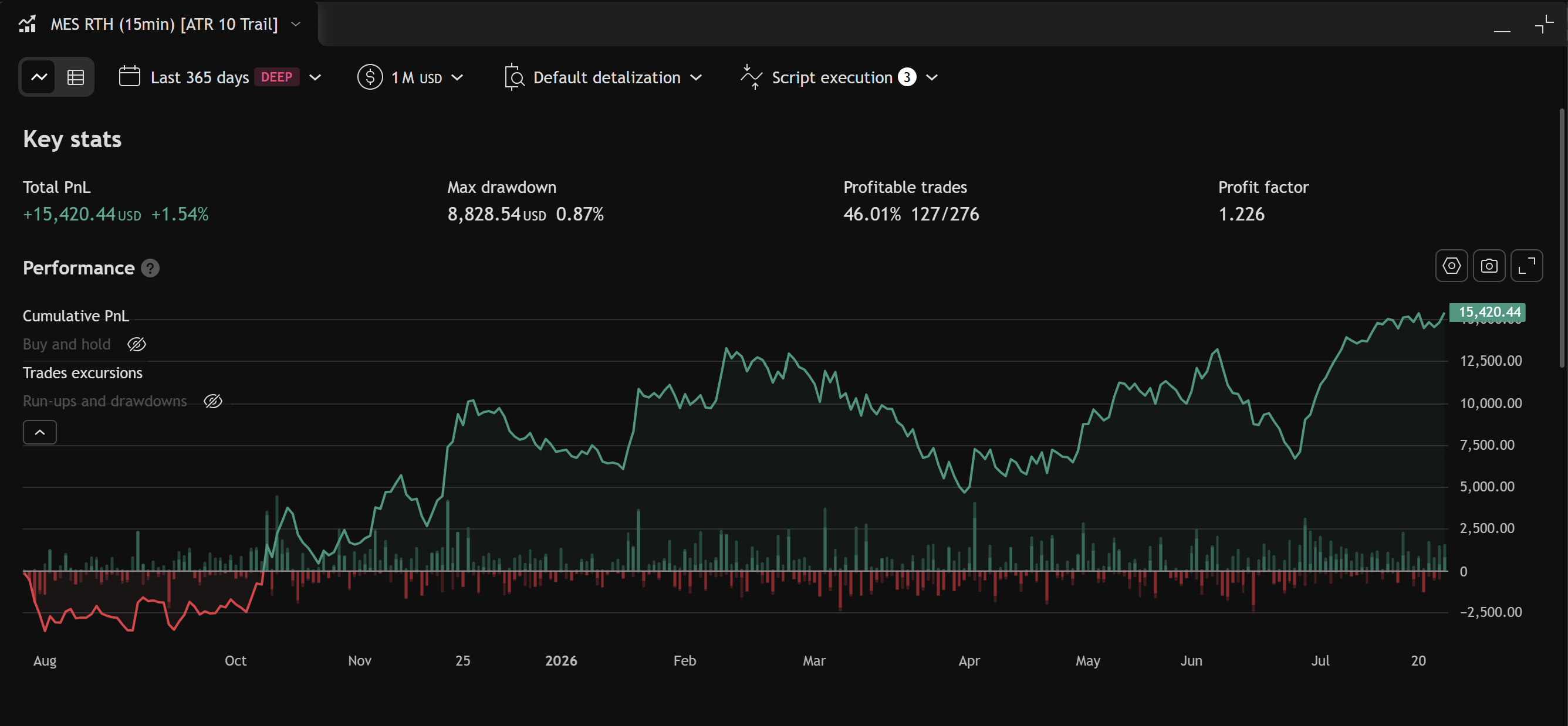
Strategy at a glance
Why MES is the best instrument for a first prop firm eval
MES is exactly 1/10th the size of the full ES contract. A full ES point is worth $50. An MES point is worth $5. That single difference changes everything about how safely you can trade during an evaluation.
On a 50k Topstep account with a $2,000 Maximum Loss Limit: 5 MES contracts with a 10-point stop costs $250 per losing trade — giving you eight full stop-outs before the floor is threatened. The same setup on ES full contracts costs $2,500 per trade — breaching the entire Maximum Loss Limit on the very first stop. That's not a trading problem, that's a contract size problem, and it eliminates more evaluations than bad strategy logic ever will.
- $1.25/tick: Meaningful position sizing within strict daily loss limits on all major firms
- Highly liquid: Tight bid-ask spread, fast fill times, no slippage surprises
- Universal access: Available on Apex, Topstep, MFFU, Bulenox, Tradeify, and all other CME futures prop firms without special permissions
- Identical chart to ES: Every setup, every support/resistance level, every indicator value is the same as the full ES — just 10x cheaper per trade
The MES ATR 10 Trail strategy — how it works
MES has a well-known tendency to trend cleanly within the RTH session once direction establishes — the kind of move a fixed stop either exits too early or holds too long through. An ATR-based trailing stop solves that by adapting to how much the market is actually moving that session, rather than using one static distance every day.
ATR-Based Trailing Stop
Stop distance is set from a 10-period ATR reading and trails with the position as it moves in your favor — tight in quiet sessions, wider in volatile ones.
Bar-Close Entries
All entries trigger on confirmed 15-min bar close. No intrabar fills, no repainting. What backtests is what executes live.
Daily Kill Switch
Trading halts automatically once session losses hit the configured threshold. Configurable per firm's daily loss limit.
RTH Session Only
Trades the regular trading session only — flat before the close, no overnight exposure carried into the next day.
The PDF guide included with the Starter plan walks through the exact ATR multiplier, entry filters, and per-firm parameter settings — the settings that let you dial risk to the dollar for your specific account size.
Contract sizing for 50k prop firm accounts
Because the stop trails with ATR rather than sitting at a fixed distance, exact per-trade risk varies session to session. The table below gives conservative starting contract counts for each major firm at the 50k tier — the PDF guide covers how to size precisely against your firm's daily and trailing drawdown limits.
| Firm | Daily Loss Limit | Starting Contracts |
|---|---|---|
| Apex 50k | None | 5 MES |
| Topstep 50k | $1,000 | 4 MES |
| MFFU 50k | $500 | 2 MES |
| Tradeify 50k (Growth) | None | 6 MES |
| Bulenox 50k | None | 5 MES |
These are starting points — not maximums. The PDF guide included with the Starter plan walks through how to scale contract count as your equity buffer grows during the evaluation, and when to pull back if early sessions go against you.
Prop firms that work well with MES
Topstep — EOD trailing, no mandatory daily limit
Topstep's EOD trailing drawdown is a good fit for a trailing-stop strategy — intraday floating drawdown while a trend develops doesn't move your floor, only closed equity does. Four MES contracts is a comfortable starting size well within the $2,000 Maximum Loss Limit, Topstep's only mandatory account floor.
Apex — no daily loss limit, intraday trailing
No daily loss limit means the kill switch only needs to protect the intraday trailing drawdown floor — not an artificial session cap. Five contracts is a reasonable starting size; the ATR trail's adaptive stop keeps risk in proportion to the session's actual volatility rather than a fixed distance that's sometimes too tight and sometimes too loose.
MyFundedFutures — static drawdown, $500 daily limit
MFFU's $500 daily limit requires the most conservative sizing: 2 MES contracts to start. The upside is the static drawdown floor never moves as you profit — a strong week early in the evaluation increases your effective buffer rather than tightening a trailing floor.
Bulenox — static drawdown, no daily limit
Bulenox's static drawdown and no daily limit is the most relaxed environment for this strategy. Five contracts, no session-level cap — good if your early sessions run choppy, since the static floor absorbs losing runs better than EOD trailing.
MES vs ES — when to use which
| MES — Starter ($24/mo) | ES — Pro ($39/mo) | |
|---|---|---|
| Tick value | $1.25 | $12.50 |
| 1 point value | $5.00 | $50.00 |
| Best account size | 50k | 100k–150k |
| Best for | First eval, learning automation | Established setup, larger accounts |
MES and ES run different strategies, each tuned to the contract's dollar value and the account sizes each plan targets. Many traders start on MES for a first 50k eval, then move to the Pro/ES plan once they're managing a larger funded account.
Get the MES Pine Script — Starter plan, $24/mo.
ATR 10 Trail strategy, 15-min RTH. Daily kill switch, bar-close entries, TradersPost webhook output. Pine Script + PDF guide, invite-only on TradingView within 24 hours. Works on the free TradingView plan.
Subscribe — $24/mo Need ES instead?Frequently asked questions
What is an MES Pine Script strategy?
An MES Pine Script strategy is an automated trading strategy written in TradingView's Pine Script language for the Micro E-mini S&P 500 futures contract. The script identifies setups automatically, fires entries on bar close, manages the stop and target, and sends alerts to TradersPost for hands-free execution on your prop firm account. You get invite-only access to the script on TradingView plus a PDF guide — accept the invite and add it to your chart from Indicators & Strategies → Invite-Only Scripts, and it's ready to run.
Is MES good for 50k prop firm accounts?
Yes — it's one of the best choices. At $1.25/tick and $5/point, MES lets you run several contracts while keeping per-trade risk well within a 50k account's daily loss limit. That gives the strategy room to work through normal losing runs without a single bad session ending the evaluation. The PDF guide covers exact contract sizing per firm.
Can I automate MES trading on Topstep or Apex?
Yes. The workflow: TradingView fires an alert when the Pine Script signals an entry or exit → TradersPost receives the webhook → order placed at your Tradovate or Rithmic account automatically. Both Apex Trader Funding and Topstep explicitly permit automation on the evaluation and funded accounts. No manual clicking, no hesitation, no missed entries.
What is the difference between MES and ES for prop firm evals?
MES and ES trade the same underlying S&P 500 index, but the two plans run different strategies sized to each contract's dollar value. MES: 1 tick = $1.25, 1 point = $5. ES: 1 tick = $12.50, 1 point = $50. For a 50k account, ES-sized risk is dangerously large relative to typical daily loss limits — MES lets you size meaningfully without blowing the daily limit on one or two trades. Our Starter plan ($24/mo) covers MES. The Pro plan ($39/mo) covers ES for 100k-150k accounts.