Pine Script Strategy · Pro Plan
ES Pine Script Strategy for Prop Firm Evaluations
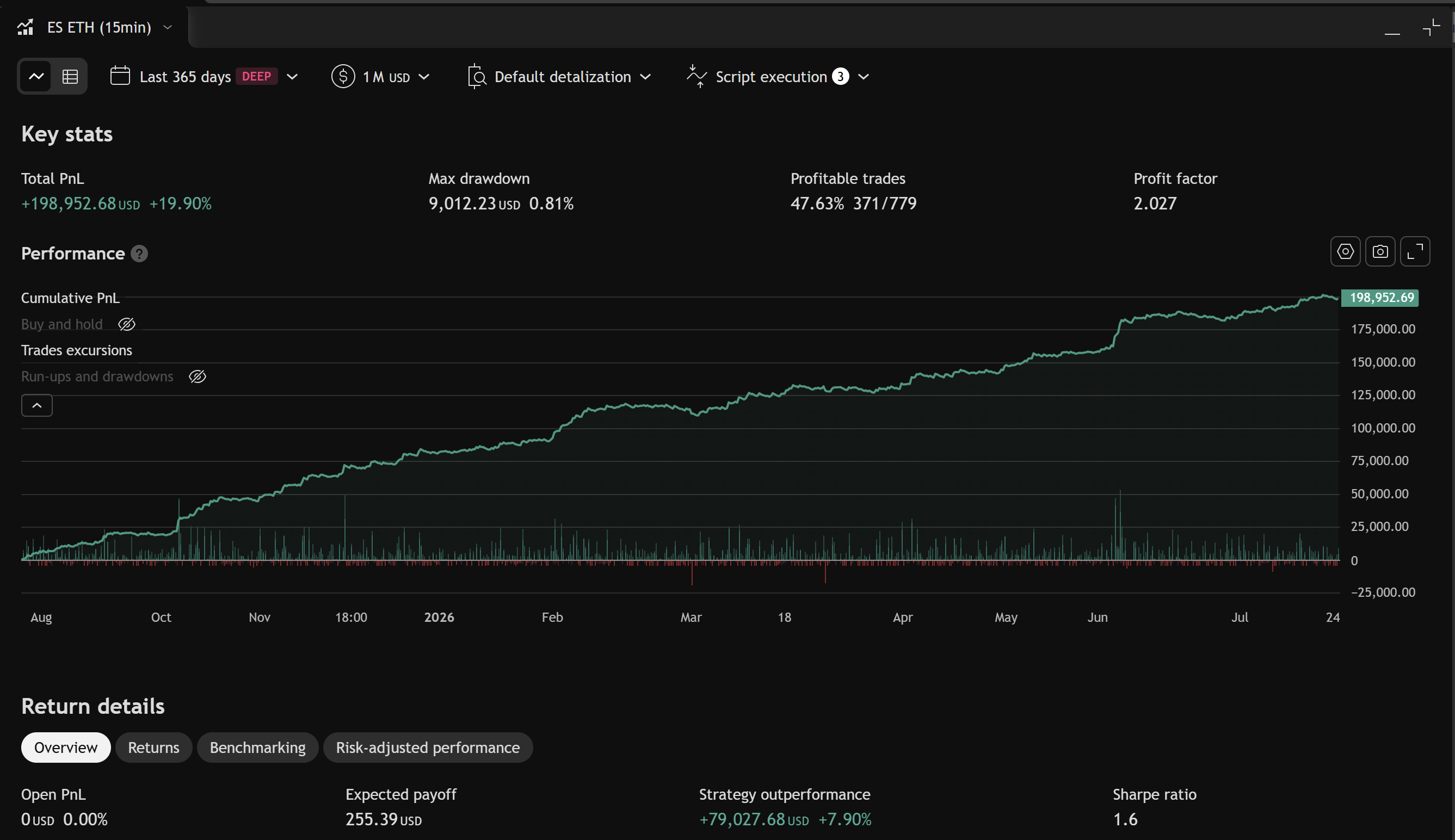
ES is the flagship S&P 500 futures contract — $12.50 per tick, $50 per point. One well-timed trade can fund a full session. One mismanaged trade can breach a daily limit. The strategy we actually run: ES ETH (15min). 47.63% win rate across 779 trades, +$198,952 net, $9,012 max drawdown.
Why ES for prop firm evals — the liquidity edge
ES is the world's most liquid futures contract. The bid-ask spread is typically 1 tick ($12.50), and institutional volume keeps it deep even during fast-moving sessions. At 2 contracts, you can fill immediately without meaningful slippage — something that matters when your Pine Script fires on a bar close and needs an instant market-order execution at your broker.
The math works cleanly at the 100k tier. An Apex 100k evaluation requires $6,000 profit. At $50/point on 1-2 contracts, that's a realistic target across a focused multi-week eval run without taking excessive risk per session — the backtest above shows the strategy clearing that bar many times over across 779 trades.
The ES ETH (15min) strategy — how it works
Rather than trading only the regular session, this strategy also works the extended trading hours (ETH) — the overnight and pre-market session where price often establishes the moves that carry into the RTH open. Running on the 15-minute chart smooths out the noise that trips up faster timeframes during lower-liquidity overnight hours.
ETH Session Coverage
Trades across extended hours, not just 9:30–4:00 ET — capturing setups that a RTH-only strategy would miss entirely.
Bar-Close Entry Only
Entries fire on confirmed 15-min bar close — no intrabar triggers. What you see in the backtest is what executes live. No repainting on wick touches.
Defined Risk Per Trade
Risk per trade is fixed and known before the signal fires — no discretion, no averaging into a loser.
Daily Kill Switch
Once cumulative session losses hit a configurable threshold, no new entries fire for the remainder of the session.
The PDF guide included with every Pro plan purchase covers the exact entry logic, stop sizing, and per-firm parameter settings — including kill switch thresholds and maximum contracts permitted per account size.
Sizing and risk per prop firm — 100k accounts
| Firm | Account | Daily Limit | Starting Contracts |
|---|---|---|---|
| Apex | 100k | None | 2 ES |
| Apex | 150k | None | 2 ES |
| Topstep | 100k | $2,000 | 1 ES |
| MyFundedFutures | 100k | $1,000 | 1 ES |
| Tradeify (Growth) | 100k | None | 2 ES |
The PDF guide included with every Pro plan purchase covers exact parameter settings for each firm, including kill switch thresholds, session filter times, and maximum contracts permitted per account size.
Which prop firms work best with ES
Apex Trader Funding (100k / 150k)
Best overall for ES. No daily loss limit means you can run 2 ES contracts without a session-ending hard stop from the firm side. Apex's intraday trailing drawdown follows your peak equity tick-by-tick — defined exits at fixed profit levels handle this cleanly rather than leaving winners open-ended.
Topstep (100k)
Strong fit. The 100k Combine has no mandatory daily loss limit — the $3,000 Maximum Loss Limit is what constrains you to 1 ES contract as a starting size — the PDF guide covers exact per-trade risk sizing. Topstep's EOD trailing drawdown is particularly favorable for a strategy trading extended hours: floating overnight moves don't raise the floor prematurely — only closed session equity matters.
MyFundedFutures (100k)
Conservative but viable. $1,000 daily loss limit and static drawdown (floor never moves). 1 ES contract is a reasonable starting size. The static floor is actually the most predictable structure for a systematic strategy — you know your exact risk parameters from day one and they don't change as you profit.
FTMO (NAS100 / indices)
FTMO trades CFDs rather than CME futures. They don't offer ES directly — their S&P instrument is the US500 or SPX500. If you're on FTMO, the NQ strategy is more directly applicable. Our Pro plan covers both ES and NQ sizing configurations.
ES vs MES — which plan you need
ES and MES run different strategies, each tuned to that contract's dollar value and target account size. The main difference for choosing between them is contract size:
| ES — Pro Plan ($39/mo) | MES — Starter Plan ($24/mo) | |
|---|---|---|
| Tick value | $12.50 | $1.25 |
| 1 point | $50.00 | $5.00 |
| Account tier | 100k – 150k | 50k |
| Daily limit fit | 100k accounts | 50k accounts |
If you're not sure which to start with, start with MES on a 50k account — the dollar exposure is 10× lower while you get comfortable with automated execution, then move up to the Pro/ES plan as you manage larger funded accounts.
Get the ES Pine Script strategy — Pro plan, $39/mo.
ES ETH (15min) strategy, fixed risk, bar-close entries, daily kill switch, and TradersPost webhook output. Pine Script file + PDF guide, invite-only on TradingView within 24 hours. Works on the free TradingView plan.
Buy Pro Plan — $39/mo Need MES instead?Frequently asked questions
What is an ES Pine Script strategy?
ES is the E-mini S&P 500 futures contract traded on the CME. A Pine Script strategy automates entry and exit logic on TradingView — in this case the ES ETH (15min) strategy — and fires alerts that route to TradersPost for live order execution on your prop firm account at Tradovate or Rithmic. No manual clicking required.
Is ES good for 100k prop firm accounts?
Yes. At $50 per point and $12.50 per tick, ES gives meaningful dollar returns without needing large contract counts. One to two contracts fits cleanly within most 100k firm daily limits. The liquidity also means fills are clean — 1-tick slippage at most even on fast-moving sessions.
What prop firms support ES futures trading?
All major CME futures prop firms: Apex Trader Funding, Topstep, MyFundedFutures, Tradeify, Bulenox, TradeDay, Funded Next, and others that execute through Tradovate or Rithmic. ES is available on all of them — check your firm's specific contract list and max position limits before going live.
Should I trade ES or MES on a prop firm eval?
Use MES for 50k accounts — the Starter plan at $24/mo. Use ES for 100k–150k accounts — the Pro plan at $39/mo. Each plan runs a strategy sized to that contract's dollar exposure; MES has one-tenth the dollar exposure per tick ($1.25 vs $12.50), making it the safer entry point for smaller account sizes.
Can I automate an ES Pine Script on a prop firm account?
Yes — using TradingView alerts wired to TradersPost, which routes the signal to your Tradovate or Rithmic account and places the order automatically. All major futures prop firms permit algorithmic automation. Confirm your specific firm's funded-account automation policy before connecting a live webhook.