Pine Script Strategy · Pro Plan
NQ Pine Script Strategy for Prop Firm Evaluations
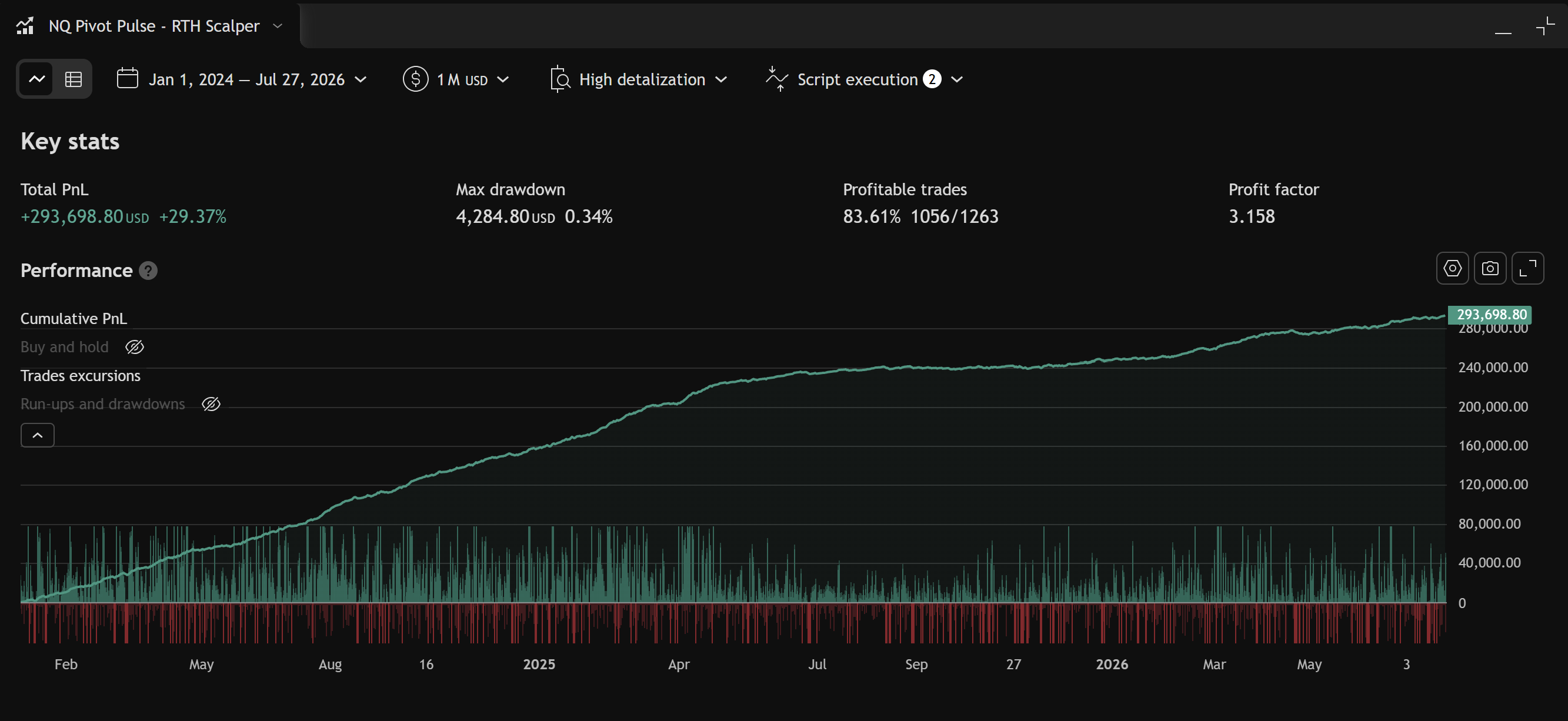
NQ is the highest-volatility, highest-payout futures contract for prop firm trading. One point = $20. At 100k–150k account sizes, the math works in your favor — but only if the strategy respects the risk rules. Ours does: the NQ Pivot Pulse RTH Scalper. +$293,698 backtested across 1,263 trades, 83.61% win rate, profit factor 3.158.
Why NQ for prop firm evals — the volatility edge
NQ averages 200–400 index points of intraday range. At $20 per point, that's $4,000–$8,000 of movement per contract per day. No other CME futures product offers that combination of liquidity and dollar range at a tradeable margin level for prop firm accounts.
For 100k–150k prop firm accounts, this means meaningful profit targets are achievable without needing a huge number of contracts. The strategy is a scalper by design — it takes many trades across the RTH session rather than waiting for one or two setups a day, which is exactly why the backtest above shows over a thousand trades and a win rate well above breakeven.
Compare that to MNQ: same underlying index, but $2/point instead of $20 — the Pro and Starter plans each run a strategy tuned to that contract's dollar exposure. MNQ is the right choice for 50k accounts. NQ is the right choice when you want the full dollar output of the Nasdaq-100 contract behind every signal.
The tradeoff: NQ margin is significant (~$16,000–$20,000 per contract), and daily limits matter more at this dollar-per-point level. The natural pairing is a 100k account with no daily loss limit — Apex 100k or Tradeify Growth 100k — where you have the most room to let a high-frequency scalper run a full session.
The NQ Pivot Pulse RTH Scalper — how it works
Rather than waiting for one or two clean setups a day, this strategy scalps the Regular Trading Hours session, taking many smaller, high-probability trades off short-term pivot levels rather than a handful of large swing trades.
Pivot-Based Entries
Signals trigger off short-term pivot structure rather than a lagging indicator crossover — designed to catch NQ's fast intraday swings early.
Bar-Close Entries
Entries confirm on bar close — no intrabar fills that look different live versus backtest.
High Trade Frequency
Backtested across 1,263 trades — enough sample size to see the edge hold up across many different market conditions, not just a handful of lucky sessions.
Daily Kill Switch
Configurable daily loss cap stops new entries if the session goes against you — essential on any NQ account given the contract's dollar-per-point size.
The PDF guide included with the Pro plan covers the exact entry logic, stop sizing, and per-firm parameter settings.
Prop firm sizing for NQ — account by account
| Firm | Account | Daily Limit | Starting Contracts |
|---|---|---|---|
| Apex | 100k | None | 2 NQ |
| Apex | 150k | None | 3 NQ |
| Topstep | 100k | $2,000 | 1 NQ |
| FTMO | 100k | $1,000 | 1 NQ |
| Tradeify Growth | 100k | None | 2 NQ |
| MyFundedFutures | 100k | $2,000 | 1 NQ |
Which prop firms work best with NQ
Apex Trader Funding — 100k / 150k
Apex is the top pick for NQ. No daily loss limit on any account tier means a high-frequency scalper can run a full session without a circuit breaker cutting it off. The intraday trailing drawdown on Apex does require clean, disciplined exits — which is exactly what a systematic scalper delivers trade after trade. 2 NQ contracts is a solid starting size on a 100k account.
Topstep 100k
Topstep's $2,000 daily loss limit on 100k keeps NQ sizing to 1 contract safely. The big advantage: EOD trailing drawdown. NQ's wide intraday swings don't move the drawdown floor — only closed session equity does, which suits a strategy taking many trades through the session.
FTMO
FTMO uses the NAS100 cash instrument rather than CME NQ futures — same underlying index, slightly different contract specs ($1/point on some configurations vs $20 on CME NQ). The $1,000 daily limit on a 100k account is tight for NQ; 1 contract is the viable starting configuration. FTMO is viable but not the optimal NQ pairing.
Tradeify Growth 100k
No daily loss limit on the Growth eval path. EOD trailing drawdown (same advantage as Topstep). 2 NQ contracts is workable. Lower name recognition than Apex but rules are genuinely algo-friendly.
NQ vs MNQ — when to use which
| NQ (Pro Plan — $39/mo) | MNQ (Starter Plan — $24/mo) | |
|---|---|---|
| Dollar per point | $20 | $2 |
| Typical account size | 100k–150k | 50k |
| Best firm pairing | Apex 100k, Topstep 100k | Apex 50k, MFFU 50k |
| Margin per contract | ~$16,000–$20,000 | ~$1,600–$2,000 |
NQ and MNQ run different strategies, each tuned to that contract's dollar exposure and target account size. If you're running a 50k eval, start with MNQ. When you step up to a 100k+ account, the Pro/NQ plan is built for that scale of contract.
Backtested performance breakdown
Backtested on TradingView, NQ RTH session — full report above.
- Net profit: +$293,698
- Total trades: 1,263
- Win rate: 83.61%
- Profit factor: 3.158 (for every $1 lost, $3.158 is made)
- Max drawdown: $4,285 (0.34% of account)
Get the NQ Pine Script strategy — Pro plan, $39/mo.
+$293,698 backtested. 83.61% win rate. NQ Pivot Pulse RTH Scalper, daily kill switch. Pine Script file + PDF guide, invite-only on TradingView within 24 hours.
Buy Pro Plan — $39/mo Need MNQ instead?Frequently asked questions
What is an NQ Pine Script strategy?
NQ is the Nasdaq-100 E-mini futures contract ($20/point). A Pine Script strategy codes entry, stop, and exit rules on TradingView and fires alerts when conditions are met. Those alerts route to TradersPost, which places the order on your Tradovate or Rithmic account at your prop firm — no manual clicking required.
Is NQ good for 100k prop firm accounts?
Yes. At $20/point, NQ's typical 200–400 point daily range gives 2 contracts enough room to hit meaningful profit targets across a session. On a 100k Apex account (no daily limit), 2 NQ contracts is a conservative starting size. The PDF guide covers exact per-trade risk sizing.
What prop firms allow NQ trading?
All major futures prop firms permit NQ: Apex Trader Funding, Topstep, MyFundedFutures, Tradeify, Bulenox, TradeDay, and Funded Next. FTMO uses the NAS100 cash instrument rather than CME NQ futures — same underlying index, but contract specs differ slightly. The PDF guide included with the Pro plan covers firm-specific sizing for each.
What is the difference between NQ and MNQ Pine Script strategies?
Same underlying index, different dollar output and different strategy tuned to each. NQ = $20/point. MNQ = $2/point (one-tenth). The Pro plan ($39/mo) covers NQ for 100k–150k accounts. The Starter plan ($24/mo) covers MNQ for 50k accounts. If you want to start smaller before committing to a 100k account, start with MNQ.
Can I run this on Apex without a daily loss limit concern?
Yes. Apex Trader Funding has no daily loss limit on any evaluation tier, which is one of the main reasons it pairs well with a high-frequency NQ strategy. The intraday trailing drawdown still applies — the strategy's disciplined, systematic exits are designed to lock in gains before the trail can tighten against you.